


With Donald Trump drawing so much attention to his outrageous demands and acts of international piracy, it is hardly surprising that, with notable exceptions, little attention is paid in Ireland to problems caused by the European Union.
One exception is the CPI. Opposition to the European Union has been party policy since that capitalist bloc’s formation. For long, though, the Communist Party has been fighting an uphill battle against the overwhelming influence of the Irish ruling class, supported by its subservient media and a compliant political establishment. Yet there may be the prospect that this attitude could change, albeit not necessarily in a progressive direction.
In the meantime, though, we are told, on an almost daily basis, that the Republic’s so-called prosperity is due to its membership of the EU. So intense is the pro-EU propaganda that to challenge the received wisdom is to risk being deemed deranged at best. Seldom do we hear or read in the mainstream media that the Republic’s prosperity is not just precarious but ill-divided.
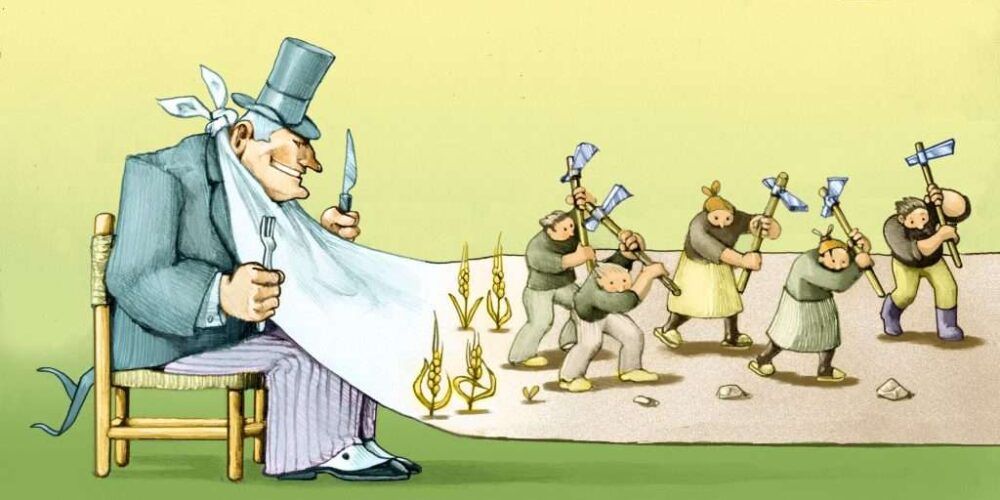
A recent report published by Oxfam Ireland[1] highlights the huge disparities of wealth in the 26 Counties. Its findings are stark: the top 10% of Irish households hold half of all wealth, with the top 1% owning 13%, and 11 billionaires collectively wealthier than 85% of the population combined. The charity describes such extreme inequality as a ‘policy failure’, pointing to budgets that worsen inequality.
The outworking of this grave inequality is there for all to see: almost 17,000 officially homeless and, according to the Simon Community[2], perhaps ten times as many living in what they describe as hidden homelessness. This is before mentioning the despair arising from a two-tier health service or the burden of education costs faced by working-class families.
Such extreme disparities of wealth, coupled with the lived experience of poverty and hardship, lead inevitably to discontent and anger. This deep frustration with the existing system has opened a door to the fascists, who are currently focusing on deprived working-class communities. However, and in spite of their determined efforts, these thugs are not having a major impact in terms of recruitment or electoral success. There is a danger, though, that this may change due to a number of factors. One major factor is membership of the EU, with its relentless insistence on free-market economics resulting in hardship for many.
Over recent decades, fascism has not had a coherent leadership in Ireland or more significant, societally powerful adherents. However, recent rulings emanating from Brussels may cause this to change. Two in particular: a decision last November to greatly reduce the Irish fleet’s fishing quotas and, especially, a drive now to ratify the Mercosur Treaty.
The first of these, reduced fish quotas[3], underlines the nature of Ireland’s difficulty with the EU. The Hague Preferences, a forty-year-old agreement apparently guaranteeing Irish access to its own waters, was abruptly swept aside by other member states with possibly devastating consequences for coastal fishing communities.
It is, nevertheless, the second issue, that of Mercosur, which carries the greater potential threat. This treaty is being driven by EU members, such as Germany, with large manufacturing sectors anxious to access markets in South America. In return, they are willing to tolerate cheap agricultural products being imported into the bloc regardless of the detrimental impact on European farmers’ incomes. Understandably, the powerful Irish Farmers Association is bitterly opposed to this treaty and already has the support of many TDs, including those right-wing independents led by Minister of State for Agriculture, Michael Healy-Rae.
Should Mercosur proceed as planned (and it most likely shall), it is bound to cause anti-EU sentiment to arise within an often conservative and powerful section of society. It may seem far-fetched to foresee the creation of an ultra-right, Farage-style ‘Ire-exit’ movement, but stranger things have happened.
Reflect briefly on the contents of a recent article[4] by the Financial Times’s US National Editor and Columnist Edward Luce. He wrote that Steve Bannon, Trump’s former chief strategist, is ‘… planning to open an Irish branch of Bannon’s War Room, his influential Maga daily podcast…’. In a recent interview, Bannon claimed to be looking for an Irish version of Trump. Moreover, in the same article, Luce quotes Robert O’Brien, Trump’s former national security adviser, complaining about Ireland’s left-leaning president, Catherine Connolly.
Taken together, these factors give cause for concern. Consider the effect of powerful, extremely wealthy right-wing American propagandists combining with a disgruntled Irish farming community and thereafter exploiting the misery of Ireland’s dispossessed. No leap of the imagination is required to envisage a drive to follow a course set by the Godfather-like figure in the White House. We have a precedent in that the first Fine Gael chairperson was an unapologetic follower of 20th-century European fascism.
None of which means, of course, that we should change our position vis-à-vis the European Union. There is, after all, a very healthy progressive element within contemporary Irish society. Look, for example, at the election of Catherine Connolly and the massive support for Palestine. It is, however, imperative that as disillusionment with the imperialist EU inevitably grows, this anger is properly directed. It is essential that we continue to encourage all to punch up and not down.