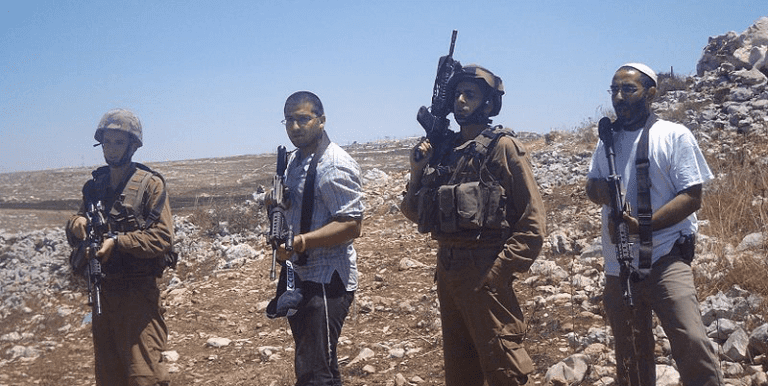


Across the hills between Nablus, Jerusalem, Ramallah, and Hebron, extremist settler groups have grown into organized violent formations that intimidate Palestinians on a daily basis. Comprised mainly of ideologically driven young religious settlers, these groups have become the most dangerous field arm in Israel’s project to assert control over West Bank territory, especially in Area “C.” Though they operate outside formal state structures, their actions align closely with government settlement expansion policies.
Recently, a new organization—the Hilltop Beasts—has gained notoriety. Cited in Hebrew media, the group consists of dozens of extremist settlers responsible for arson attacks, village raids, and assaults on farmers and shepherds. Yedioth Ahronoth described them as representing a new wave of unrestrained extremism. Reports from Ma’an News Agency in October 2025 indicate that their activities reflect a significant escalation in settler violence. The hills between Nablus, Ramallah, and southern Hebron have become chronic flashpoints, often with indirect backing from nearby Israeli military units.
Extremist Settlement Organizations in the West Bank Hills
Price-Tag Gangs
Emerging around 2008, these gangs carry out retaliatory attacks against Palestinians in response to the demolition of illegal outposts or any government actions perceived as obstructing settlement expansion. Their methods include burning olive trees and crops, vandalizing property, desecrating mosques and churches, and spray-painting racist graffiti signed “Price Tag.” Their operations follow a consistent, organized pattern, often executed at night.
Hilltop Youth
Formed between 1999–2000, the Hilltop Youth established illegal outposts on strategic hills, deliberately challenging Israeli law. Their ideology blends religious and ultranationalist extremism, drawing inspiration from Kahanist currents. Despite lacking centralized leadership, they maintain a core of activists who repeatedly participate in violent raids and vandalism, often linked to Price-Tag attacks. Human rights organizations have documented their involvement in systematic arson and physical assaults. On October 1, 2024, the U.S. Treasury imposed sanctions on this group, signalling international recognition of the threat it poses.
Hilltop Girls
This network of female activists is affiliated with the Hilltop Youth but sometimes operates independently. They espouse similar extremist ideologies and engage in harassment of Palestinian farmers, crop theft, and aggressive encounters under the guise of agricultural work. Media coverage and online videos show their increasing involvement in organized settlement violence.
Hilltop Beasts
A term used by Ynet and Yedioth Ahronoth in 2025 to describe groups of highly violent youth extremists. Their actions include shootings, widespread arson against crops, homes, and vehicles, and repeated nighttime assaults on isolated Palestinian communities. They represent the most extreme evolution of unofficial settler violence, conducting semi-organized terrorist attacks with near-total impunity.
Support Structure: Military Protection, Political Cover, and International Funding
Although Israeli governments formally deem unauthorized outposts illegal, on-the-ground practices reveal a different reality. According to a March 2024 report by B’Tselem, Israeli soldiers frequently stand by during settler attacks without intervention. In some cases, they arrest Palestinians for “disturbing the peace” while settlers retreat unharmed.
Politically, far-right parties such as Religious Zionism (led by Bezalel Smotrich) and Otzma Yehudit (led by Itamar Ben-Gvir) provide explicit ideological and political cover. Both leaders support settlement expansion and advocate legalizing outposts built by the Hilltop Youth. As Finance Minister and head of the Civil Administration, Smotrich redirected state funds to build infrastructure in outposts, effectively normalizing them. Ben-Gvir publicly encouraged widespread civilian armament, enabling tens of thousands of settlers to carry firearms, thus empowering individuals to act as autonomous enforcers.
Financial support also flows from right-wing Jewish organizations in the United States and Europe. These groups sponsor “Torah farms,” which serve as fronts for land seizure. Important funders include Regavim (linked to Smotrich), Amana (the operational arm of Gush Emunim and subject to U.S. sanctions), along with charities such as the Central Fund of Israel and the Hebron Fund. Together, military protection, political advocacy, and transnational funding form a comprehensive support system that transforms extremist settler groups into an unofficial mechanism for asserting Israeli dominance over Area “C.”
Targeting Palestinians: Patterns of Systematic Violence
The attacks carried out by the Hilltop Youth, outposts, and Hilltop Beasts follow consistent and coordinated patterns:
- Physical assaults and shootings: Numerous cases involve live fire directed at Palestinian civilians—including women and children—resulting in injuries and fatalities, alongside home invasions and direct threats.
- Arson of farmland: Large-scale fires targeting olive groves and crops, as documented in villages like Turmus‘ayya by B’Tselem and OCHA, effectively prevent Palestinians from accessing their land.
- Property destruction: Homes, vehicles, shops, and factories are burned or vandalized during organized raids that occur with minimal military intervention.
- Attacks on farmers and herders: Theft of livestock, poisoning of animals, and destruction of agricultural infrastructure, solar panels, and water tanks contribute to economic collapse and land abandonment.
- Pastoral outposts: Settlers erect tents and caravans on pasturelands, later designating them as “state land,” forcing Palestinian communities to leave.
- Forced displacement: Between 2023 and 2025, thousands of Palestinians—especially rural and Bedouin communities—were displaced amid unprecedented violence and land seizures.
Impact on Palestinian Land and Social Reality
These extremist groups reshape West Bank geography beyond traditional settlement expansion:
- Incremental land confiscation: Agricultural fields are swiftly converted into new outposts or religious sites linked to larger settlement blocs.
- Economic decline: Restricted access to farmland impoverishes rural communities and drives migration to safer areas.
- Closure of Palestinian hill areas: Military posts and armed settler encampments prevent Palestinians from using their lands for farming or grazing.
- Normalization of dispossession: Official rhetoric labeling the territory as “disputed” provides a narrative cover while settler groups consolidate control on the ground.
Unofficial Violence under Official Cover
Reports from B’Tselem and Yesh Din increasingly suggest that the Israeli army not only tolerates settler attacks but sometimes facilitates them. Palestinians defending their land are frequently arrested, while attackers face limited or no accountability. This dynamic transforms what appears to be uncoordinated violence into an informal yet consistent strategy of demographic pressure and territorial takeover.
Conclusion: Systematic Violations and the Need for International Action
The widespread targeting of civilians, farmland, infrastructure, and property constitutes grave breaches of the Fourth Geneva Convention. Palestinians face relentless threats to their safety, mobility, and livelihoods, while perpetrators remain shielded from prosecution. These actions undermine diplomatic processes, destabilize regional relations, and entrench cycles of violence.
Groups such as the Hilltop Beasts function as organized paramilitary actors under unofficial state protection. Their attacks on Palestinians, their role in land seizure, and their contribution to forced displacement violate both human rights law and international humanitarian law. Israeli governmental complicity and military protection render these violations systematic. Urgent international intervention is necessary to protect civilians, ensure accountability, and uphold legal norms before large parts of the West Bank are permanently transformed through unlawful settlement expansion and displacement.