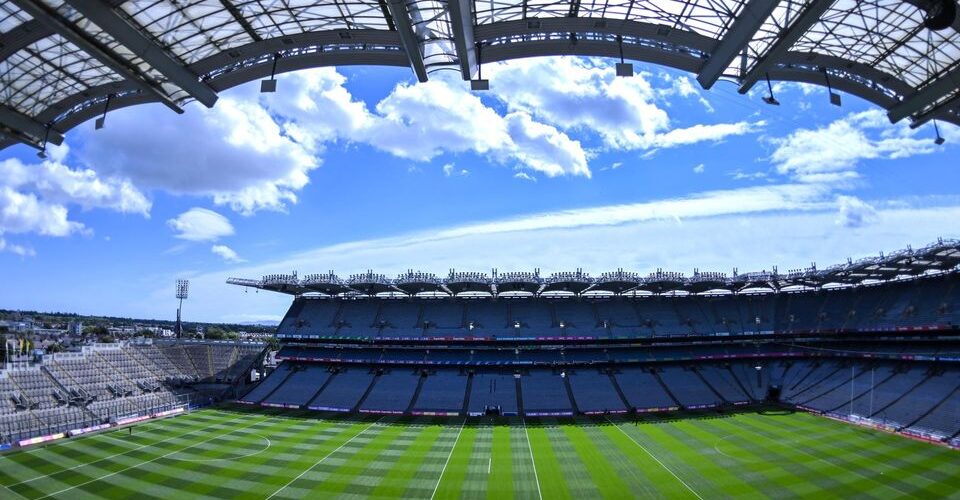

A slow burning but significant class conflict is unfolding within Cumann Luthchleas Gael [the Gaelic Athletic Association or GAA]. It pits the Association’s corporate-aligned leadership against its grassroots membership, with the flashpoint being a sponsorship deal with the German insurance giant Allianz. This is not merely a disagreement over branding; it is a stark illustration of how capital seeks to subjugate community institutions, and how solidarity with Palestine has become a frontline in the struggle against imperialism.
The facts are clear. Allianz invests in Israeli banks that fund illegal settlements and provides insurance for infrastructure built on stolen Palestinian land. It is a financier and enabler of the Zionist genocide. For over a year, grassroots Gaels—players, volunteers, and club members from working-class communities across Ireland—have campaigned to #DropAllianz. Their campaign, supported by Gaels Against Genocide, is a principled application of the Palestinian-led Boycott, Divestment, and Sanctions (BDS) movement.
The response from the GAA’s top brass in Croke Park has been one of arrogant dismissal. They have ignored motions from county boards and clubs, framing the multi-million euro deal as essential for “games development” while treating the ethical revolt of their base as an irritant.
This conflict exposes a fundamental class divide within the GAA’s structure.
- The Corporate Leadership: The directors and senior administrators increasingly operate like a corporate board, viewing the Association as a commercial brand to be leveraged. Their logic is the logic of capital: revenue streams, market partnerships, and risk management. In this worldview, the source of money is irrelevant; its quantity is all that counts. Their allegiance has shifted from the community that built the GAA to the corporate partners who seek to exploit its cultural capital.
- The Working-Class Backbone: The GAA’s true power resides in its members—the volunteers who maintain pitches, run clubs, and foster a sense of collective identity rooted in place and solidarity. For them, the Association’s value is not measured in euros but in social cohesion and shared principle. Their opposition to Allianz stems from an innate understanding of injustice and a collective memory of anti-imperialist struggle. As Brendan Devenney of Gaels Against Genocide has articulated, this is about defending the very soul of the Association from commodification. The campaign asks a simple, powerful question: Should our community pride be funded by blood money?
Connecting this local struggle to global anti-imperialism is crucial. The BDS movement is not a liberal plea for charity; it is a strategic, anti-imperialist tool that targets the economic and cultural pillars supporting Zionist settler-colonialism.
By investing in and insuring the occupation, Allianz is a direct participant in imperialist exploitation. When the GAA leadership accepts its sponsorship, they are not making a neutral business decision. They are actively choosing to align a people’s institution with an imperialist project. They are laundering Allianz’s reputation through the good name of Irish community sport.
This makes the grassroots opposition profoundly socialist. It recognises that the struggle against imperialism is not confined to Gaza or the West Bank; it must be waged wherever capital and power intersect to uphold oppression. Refusing to let our cultural spaces be used as billboards for genocide is a direct challenge to the logic of global capitalism.
The GAA hierarchy hopes the movement will fade, relying on the classic tactics of delay and dismissal. Our task is to prove them wrong.
This struggle must be escalated through concrete class action:
- Club and County Motions: Every club must be encouraged to pass motions rejecting the sponsorship, creating an undeniable wave of democratic dissent from below.
- Withhold the ‘License’: Clubs and counties should refuse to use Allianz-branded equipment or promote the partnership, stripping it of its value.
- Build Alliances: Link with trade unions, other sporting bodies, and anti-imperialist campaigns to show this is part of a broader fight against corporate power.
The goal is to force a crisis of legitimacy for the Croke Park elite. They must be made to see that the GAA’s authority derives solely from the consent and participation of its members—the very people they are currently ignoring.
The fight to #DropAllianz is a defensive struggle for the GAA’s soul and an offensive action in the global anti-imperialist fight. For socialists, this is fertile ground. It shows that the consciousness for international solidarity exists in our communities. It reveals the cracks in capitalist hegemony when a local institution becomes a site of contention. Victory in this campaign would be more than ending one sponsorship; it would be a powerful demonstration that working-class people, organised through their own institutions, can confront and defeat corporate power and its imperialist alliances.
The message from the grassroots must be clear: Our clubs, our games, and our community’s good name are not for sale to the enablers of genocide. In defending that principle, we defend the very possibility of a GAA that serves its people, not profit, and take a stand in the worldwide struggle for liberation.