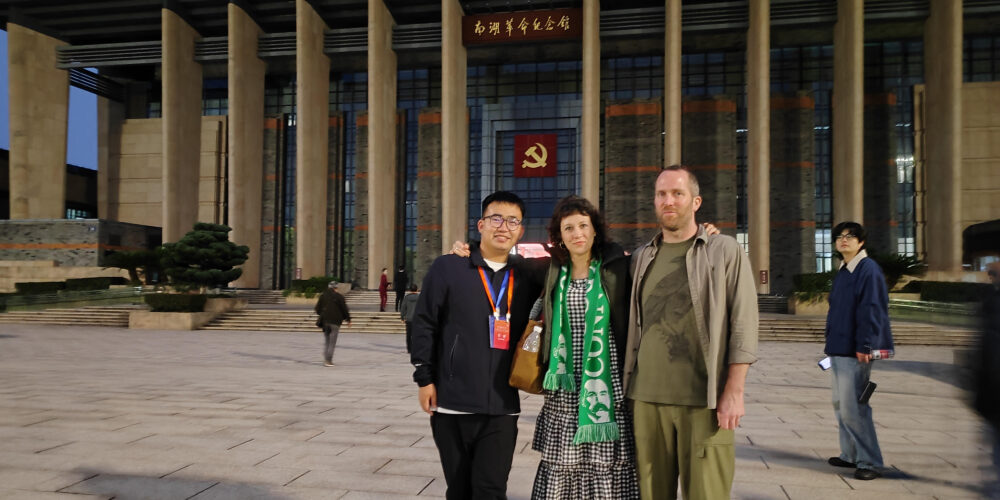

The 15th World Socialist Forum (3-4 November, Beijing, Chinese Academy of History) and the Zhejiang University International Academic Forum (7 November, Hangzhou, Zhejiang University Library) hosted by the Chinese Academy of Social Sciences (CASS) are important platforms for academics, social scientists, Marxists, and activists to exchange ideas. They are particularly important for the People’s Republic of China to tell its story to a global, likeminded audience.
The two fora and the study visit to Zhejiang province are an opportunity for the PRC to showcase a multidimensional image of the country. The fora took place during the rapid rise of Chinese development and a period of profound tectonic shifts in the geopolitical playing field and world history. The themes reflected this context. The Beijing forum was entitled ‘At the Crossroads of World History: The Choice of All Nations’ and the Hangzhou forum was about ‘The Chinese Path to Modernisation and A New Model for Human Progress.’
The Beijing forum brought together around 90 foreign participants, including internationally influential Marxist scholars, foreign communist leaders, social activists, diplomatic representatives and academics from thirty-five countries. For the second leg of the forum the international visitors were split in two groups. One travelled West to Xi’an and the other South to Hangzhou. CPI’s delegation accompanied the latter grouping. There were thirty-four international delegates participating in the Zhejiang University forum. Both events had a significant media presence.
Over the two days of the Beijing forum many top figures from the Academy of Marxism and CASS gave presentations on initiatives and policies being pursued under Chinese-style modernisation and China’s growing role as a global leader in many areas. China’s Global Development Initiative, Global Security Initiative, Global Civilisation Initiative, and Global Governance Initiative were explored in detail and expounded upon.
Chinese development and modernisation policies and achievements were also discussed at length. Speakers from both China and abroad were in agreement that China’s example shows that a non-Western path to modernisation is not only a viable project but an inspiration for socialist forces around the world.
The two representatives from the Communist Party of Ireland each gave a ten-minute speech in one of these parallel forums. The focus of our contributions was the attack on Irish neutrality in the context of great power competition and the militarisation of the EU in an era where alternative choices are being closed off by the US and NATO as part of their attempts to contain Chinese development.
The Hangzhou Forum was a more contained event, featuring a day of panels of international guests and Chinese academics discussing a range of topics. Issues that came up for discussion most frequently at both forums were: the structural crisis of the West; war and militarisation; the rise of the far-right; the multipolar transition and its contradictions; the historical legacy of the Communist movement; anti-imperialism and an alternative project; the preservation of culture in the Chinese path to modernisation; digital-intelligence civilisation and the new model of material progress; improving people’s livelihood; achieving common prosperity and the new model of social progress; harmony between humanity and nature and the new model of ecological progress.
On the first day of the Beijing Forum there was a presentation around the launch of four new books. Noteworthy is that one of the books was a Chinese translation of Sean Nolan’s ‘A Brief History of the Communist Party of Ireland’. The book was suggested for translation when a delegation of Chinese Marxist academics visited Dublin and Connolly Books earlier in the year.
The study visit to Zhejiang province was a packed itinerary of cultural events, historical sites, museums, archives, technology centres, and rural regeneration projects. The scale, and impressiveness of some of the state-of-the-art museums, libraries, and technology hubs conveyed just how important the synthesis of cutting-edge technology and preservation of culture and cultural heritage is in China’s modernisation project. During the visits to Deqing County, the Wusi Digital Village and Mogasshan Boutique Homestay Cluster we witnessed China’s dedication to ecologically minded development.
These are regeneration projects in rural areas that were previously laid waste by ecologically destructive mining industries. They embody and are the birthplace of the philosophy contained in Xi Jinping thought that lucid waters and lush mountains are invaluable assets. These projects are also part of a wider project to entice and keep younger people and families in rural areas – showing how the central government intervenes in very substantial structural ways to tackle and address negative developments like rural depopulation and uneven development.
Zhejiang is a prosperous province, the fourth richest in China. Its capital Hangzhou is an industrial powerhouse in China, known in particular for its tech innovation companies. Alibaba, Geely, Unitree Robotics, and Deepseek are all based there. In 2024, Zhejiang had 106 enterprises listed among the Top 500 private enterprises in China, ranking first nationwide for 26 years in a row. The study visit stopped at a number of headquarters of tech innovation companies like Alibaba, an augmented reality developer and a robotics company. The level of integration of Alibaba and their offshoot companies and platforms into everyday life of ordinary Chinese citizens is astonishing. It is striking how a central mission of the group is to help small businesses expand through innovation and technology, faster distribution networks, transforming their marketing and management approaches in order to compete more effectively in the market. The sheer scale and intensity of the market activity being facilitated by this company alone is difficult to fathom.
In brief, the short duration of the Zhejiang study trip and its restriction to one province limited our experience to exploring just small aspects of the technological developments, environmental and regeneration projects, and cultural preservation programmes. China is gigantic and the number and scale and diversity of areas of state-led development, cultural, environmental and infrastructure projects would be impossible to grasp in a year let alone 11 days. The rate of change and activity in construction of housing and infrastructure development is another distinctive feature. The diversity of culture and regions inside of China is also huge. It would lead one to the conclusion that the concept of ‘understanding China’ is an almost impossible task. This is something that the CPC tackles head on by making sure that members have experience in rural areas before working in towns and then cities. The trajectory of Xi Jinping’s career in the party is emblematic of this. He has worked as an official and administrator of towns and cities starting in rural settings and working his way up to prosperous regions like Zhejiang and eventually a top tier city like Shanghai.
The Party creates leaders whose understanding of their country is rooted in a lifetime of dealing with the everyday problems and experiences of the people in the most deprived and isolated areas, and successfully administering some of the most advanced cities on earth. If only we had such rigorous standards for our leadership here in Ireland.