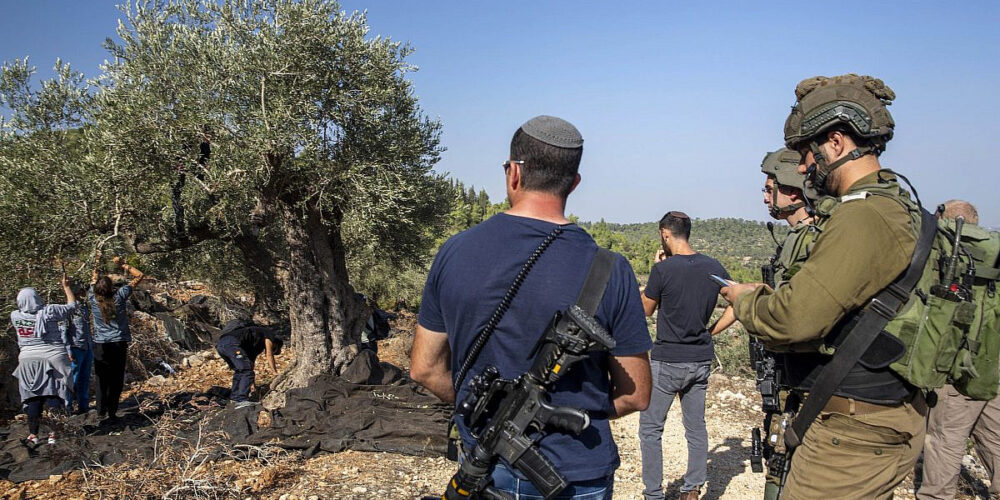


The olive harvest in Palestine is more than an agricultural event; it is a centuries-old national ritual, a living testament to the deep, material connection between the Palestinian people and their land. Yet, in 2025, this season of sustenance and solidarity was transformed into one of terror and confrontation, revealing the systematic nature of Zionist settler-colonialism in its rawest form. The unprecedented escalation of attacks reflects a deliberate policy, executed on the ground, to sever this connection and accelerate the ethnic cleansing of the Palestinian countryside.
Unprecedented Escalation of Attacks
From early October to early November 2025, the Al-Baider Organization for the Defense of the Rights of Bedouins and Targeted Villages documented approximately 390 attacks against Palestinians in the occupied West Bank. Of these, 224 were direct assaults on farmers during the olive harvest, concentrated in the governorates of Jerusalem, Salfit, Hebron, Nablus, Ramallah, Bethlehem, and Qalqilya.
These attacks are not random acts of thuggery but a coordinated strategy. The organization documented 26 cases where farmers were prevented from accessing their lands through the closure of agricultural roads and the erection of dirt barriers. Furthermore, 82 cases involved live fire and physical assaults, resulting in injuries to farmers and international solidarity activists. These physical attacks are complemented by systematic verbal threats from settler militias, designed to terrorise residents into abandoning their lands.
In areas surrounding settlements near Nablus and Ramallah, armed settlers issued direct threats, followed by 17 forced evictions and 32 cases of crop theft. The complicity of the Israeli state is explicit: journalists and human rights observers were repeatedly attacked, most notably journalist Ranin Sawafṭaṭ in the town of Beita, south of Nablus. Incursions into villages like Burin, Raba, Ein al-Duq, Sa’ir, and Turmus’ayya all occurred under the passive watch—and often active protection—of the Israeli military.
Most devastatingly, the organization documented the uprooting of over 1,710 olive trees in 36 separate incidents. This was particularly stark in the Marj Si’ area between al-Mughayyir and Abu Falah east of Ramallah, where tree destruction is a direct tool for expanding illegal settlement outposts. For villages like al-Mughayyir, Turmus’ayya, and Kafr Malik, daily attacks—from arson to theft to assault—represent a calculated policy of “creeping displacement”, fully enabled by military force.
Economic Warfare and Class Impact
Data from the Al-Baider Organization and the UN Office for the Coordination of Humanitarian Affairs (OCHA) confirm that October 2025 saw the highest rate of settler attacks since records began in 2006, averaging eight attacks per day. This is not mere lawlessness; it is a deliberate strategy of economic warfare aimed at depopulating Palestinian agricultural land.
Olive cultivation is the backbone of the Palestinian rural economy, supporting over 80,000 families. The destruction of trees and theft of crops is therefore a direct assault on the Palestinian working class and its means of subsistence. It is an attack on the national economy and a pillar of cultural identity.
The Al-Baider Organization estimates direct losses exceeding $4 million this season from stolen produce, uprooted trees, and replanting costs. The psychological toll is a key part of this war of attrition, transforming the simple act of harvesting into a life-threatening challenge. This is a campaign designed to break not just branches, but spirits.
Imperialist Complicity and the Farce of International Law
These violations constitute blatant war crimes. The uprooting of olive trees and destruction of agricultural land without legitimate military necessity is a clear breach of Article 53 of the Fourth Geneva Convention. The theft of crops and denial of access constitute collective punishment and looting, prohibited under Article 33.
From a class perspective, these practices violate the fundamental economic and social rights of the Palestinian peasantry, as codified in Article 11 of the International Covenant on Economic, Social and Cultural Rights. Physical assaults breach the right to personal security under Article 9 of the International Covenant on Civil and Political Rights.
Legally, this systematic destruction qualifies as a war crime under Article 8 of the Rome Statute. Israel bears full responsibility, both directly through its military and indirectly through its orchestration and protection of settler-colonial militias. Attacks on journalists, violating Article 79 of the First Additional Protocol to the Geneva Conventions, are part of a systematic effort to conceal the truth with impunity, shielded by Western imperial powers.
From Appeals to Resistance: The Path Forward
Appeals to the conscience of the international community have proven futile. Effective action requires a shift in strategy, grounded in grassroots resistance and international solidarity:
Build International Solidarity Brigades: Prioritise the deployment of permanent, organised international volunteers to hotspot areas like Nablus, Ramallah, and Hebron to provide a protective presence and ensure real-time documentation.
Weaponise Legal Challenges: Support and amplify the efforts of Palestinian legal organizations to bring cases before the International Criminal Court, using documented evidence to politically indict the Zionist state.
End All Complicity: Launch campaigns targeting the EU and national governments to impose meaningful sanctions, an arms embargo, and end all trade agreements with Israel that facilitate the occupation.
Fund Grassroots Resilience: Direct aid to Palestinian agricultural unions and co-operatives for replanting programs and sustainable projects, recognising this as a vital act of sumud (steadfastness) and economic resistance.
Amplify the Palestinian Narrative: Support independent media and Palestinian journalists to break the information blockade, ensuring their reports reach global audiences to counter Zionist propaganda.
Conclusion
The 2025 olive harvest exposes the core of the Zionist project: a war of annihilation against Palestinian existence. The olive tree is a symbol of peace, but in Palestine, it is a front line. Attacks on it are attacks on history, identity, and the very right of the Palestinian people to their land.
The international community’s inaction is a green light for continued ethnic cleansing. The Al-Baider Organization’s call must be heeded, but it is the organised power of the Palestinian people, supported by a global anti-imperialist and BDS movement, that will ultimately hold the criminal regime to account. The endurance of the olive tree is the endurance of Palestine itself—a symbol of a people who, despite all attempts to uproot them, remain.