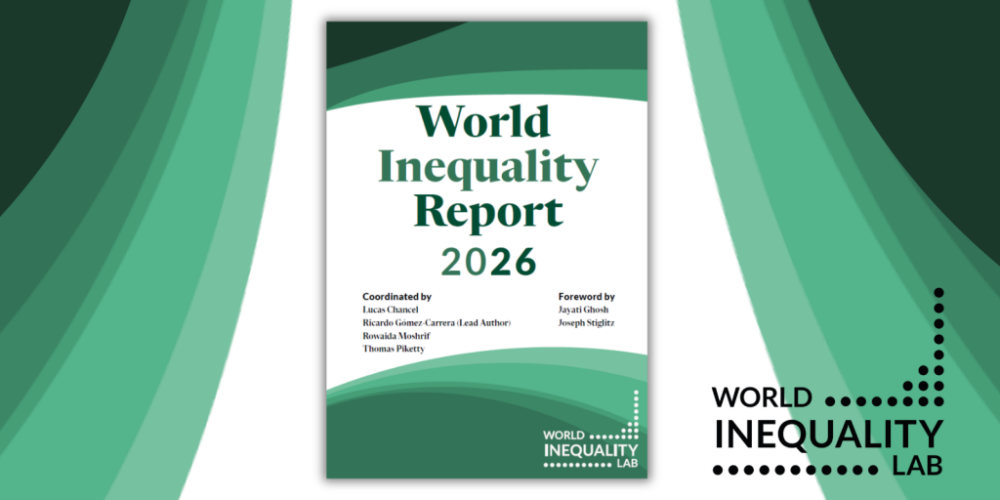


In the 25th chapter of Das Kapital, “The General Law of Capitalist Accumulation,” Marx states: “Accumulation of wealth at one pole is, therefore, at the same time accumulation of misery …at the opposite pole.” The World Inequality Report 2026 (WIR) validates this fundamental prediction. Rising inequality is a structural feature of capitalism, and its current scale is obscene.
The report analyses five key areas: the scale of global inequality; gender inequality, including unpaid labour; the structural privilege of rich countries in the international financial system; the limited impact of taxation; and how inequality corrupts democracy.
A Global Economic Shift
Historically, population growth drove economic expansion. After the 19th century, increases in per capita income became the primary driver. Between 1800 and 2025, the global population grew eight-fold (1 to 8 billion), while the average annual income per capita rose sixteen-fold, from €900 to €14,000.
Income and Wealth: Concentration at the Top
The distribution of this new wealth is profoundly unequal.
In 1820, the bottom 50% received 14% of global income. By 2025, their share had fallen to just 8%.
Today, the top 10% (556 million people) captures 53% of all income and holds 75% of all wealth.
The middle 40% (2.2 billion) receives 39% of income and holds 23% of wealth.
The bottom 50% (2.8 billion) is left with 8% of income and a mere 2% of global wealth.
Regional and National Disparities
Global inequality manifests geographically:
In 1800, the average income in North America and Oceania (1% of the population) was double that of Sub-Saharan Africa (10% of the population). By 2025, the average income in those wealthy regions (5% of the population) was 14 times larger than in Sub-Saharan Africa (16% of the population).
Latin America is the most unequal region nationally, with the top 10% taking 57% of income versus 8% for the bottom 50%.
While China has moved much of its population into the middle-income bracket since 1980, significant inequality persists.
The Grip of Wealth and Gender
Wealth concentration is even more extreme than income disparity.
In Sub-Saharan Africa, the top 10% holds 70% of national wealth, while the bottom 50% holds 1%.
In Europe, the top 10% holds 60%, and the bottom 50% holds just 3%.
Gender inequality remains systemic. Women globally earn only one-third of labour income. When unpaid domestic work is counted, women work longer hours for less pay. Structural barriers like a lack of affordable childcare and occupational segregation sustain this gap. Even in better-performing regions like Europe and North America, women’s share of labour income is only 40%, far from a fair 50%.
Modern Mechanisms of Exploitation
The WIR identifies the global monetary system as a key driver of inequality. A “structural privilege” for rich countries has replaced formal colonialism. Poorer nations are forced to pay higher interest on debt and hold low-yield assets, creating a continuous wealth drain. The bottom 80% of countries are net debtors, sustaining the positive income flows of the top 20%. This “modern unequal exchange” stifles development and maintains global hierarchy.
Climate Inequality
The responsibility for the climate crisis is also unjustly shared. The top 10% of emitters contributes 77% of emissions from private capital, while the bottom 50% contributes only 3%. The poorest, who pollute the least, bear the highest cost of climate losses.
Conclusion: A Systemic Crisis
The WIR’s data is damning, yet its analysis is incomplete. The core drivers—imperialism and neoliberalism—go unmentioned. Its proposed solutions, like progressive taxation, are superficial reforms to a systemic disease.
Inefficiency is the result of a mode of production that offers political democracy but denies economic democracy. As Artificial Intelligence (AI) threatens to accelerate capital accumulation and worsen inequality, the need for radical change is urgent. Only a decisive turn toward socialism can eradicate both the symptom and the disease.