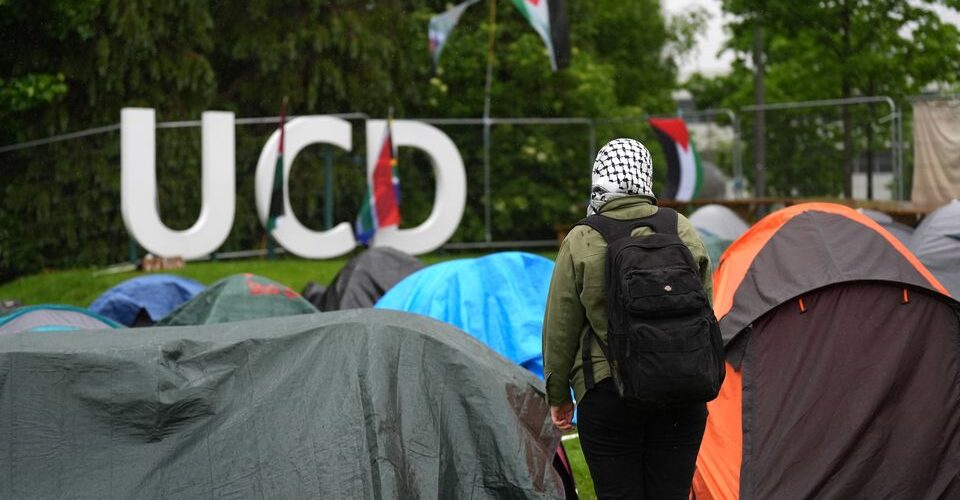
The Break the Academic Chains of Zionism (BACZ) encampment at University College Dublin (UCD) is now the longest-running university encampment in Ireland. It has done more than expose the complicity of Irish academia in the machinery of Zionist settler-colonialism. It has revealed something deeper and far more damning: the profound crisis of imperialist analysis across the Irish left.
Yes, we are here to protest UCD’s material links with the Technion and Ben Gurion University. But we are also here to hold up a mirror to a movement that has forgotten how to think structurally about power, empire, sovereignty, and national liberation.
Our tents are not just confronting UCD President Orla Feely’s collaboration with the Zionist entity. The encampment exposes the entire superstructure of Ireland’s so-called neutrality—the hollow myth our comprador bourgeoisie has fed the people for generations.
Large sections of the institutional left, who claim leadership of the Palestine solidarity movement, have refused to approach the encampment, spooked by any action that is not tidy, polite, and pre-sanctioned. Their absence is not accidental; it is ideological.
This lack of engagement illuminates a fundamental crisis: much of Ireland’s left has abandoned a revolutionary, Leninist understanding of imperialism. The refusal to move beyond moral outrage at the genocide in Gaza—to trace its roots to imperialism as a world system—is a symptom of intellectual decay. Genocide is not a humanitarian crisis or a mere tragedy. It is a logical outcome of imperialist domination. To name this requires confronting our own position within that very system.
But here lies the problem: many on the left no longer recognise that Ireland, too, is a nation shaped by centuries of colonial domination. This disconnection from our own history has produced a form of cognitive dissonance, an inability to connect Palestinian liberation with the unfinished struggle for Irish sovereignty. This colonised mindset manifests in two ways: first, through the liberal belief that moral outrage is a substitute for material action; second, through the delusion that the 26-County state’s ‘neutrality’ ever represented true independence.
Ireland’s so-called neutrality has always been a bourgeois project. It is a façade used to mask our deep integration into the imperialist core—from EU militarisation to Shannon Airport’s direct role in US military logistics. The pattern is undeniable. Yet, much of the left still treats neutrality as a treasured relic rather than a key terrain of class struggle.
The success of the UCD encampment exposes this contradiction. It forces the question: if we oppose imperialism in Palestine, how can we ignore its mechanisms operating on our own soil? This is precisely why so many left organisations keep their distance. Their entire worldview depends on upholding a romanticised version of Ireland that avoids confronting the reality of the state’s integration into the imperialist power structure.
Perhaps more than any other institution, academia reveals the colonial residue still embedded in Irish society. UCD, with its partnerships, silence, and dirty tricks to isolate us, is not an outlier but a typical example of how Irish universities serve imperialist interests. We, the non-academics and ‘unqualified’ who set up the encampment, have done what tenured academics refuse to do: expose the ideological foundations of Irish higher education as a pillar of the bourgeois state.
Our call to challenge academia and strip it of its unearned prestige is not an attack on knowledge. It is an attack on bourgeois knowledge production—the ritualised system through which empire manufactures ‘experts’ whose primary function is to justify and strengthen the neocolonial order. The academic title, like a colonial medal pinned to the chest of a loyal servant, grants authority without accountability.
Just look at the pomp of university graduations: professors dressed like medieval astrologers, muttering in specialised jargon, and reassuring the ruling class that the stars favour their continued dominance. They bestow stamps of approval on compliant graduates who march in lockstep to the beat of the imperialist drum.
The credentials of today’s academic in Ireland function less as markers of expertise and more as talismans of exclusion, designed to keep the working class outside the gates of ‘legitimate’ knowledge. Their elitism is not merely arrogant; it is parasitic, feeding off public resources while policing the boundaries of acceptable thought and solidarity.
The encampment embodies a form of politics the institutional left has forgotten: messy, confrontational, and uncompromising. It is not a panel discussion, a curated march, or a grant-funded workshop. It is not a dining experience, a merch stall, or a céilí. It is a living site of class contradiction, collective struggle, and ideological clarity. It requires discipline, sacrifice, and a willingness to confront power directly.
For many, it is safer to remain busy—crafting emails, drafting statements, and attending endless meetings where nothing is decided. It is safer to cling to an activism that is clean, respectable, and career-safe. Supporting the encampment would require these groups to abandon their comfort and demonstrate solidarity not as performance, but as revolutionary practice.
Avoiding the camp protects them from two things:
The ideological challenge: forcing a reckoning with imperialism as a material system in which they are complicit.
The organisational challenge: a model of resistance that is not controlled by NGO bureaucracies, party machines, or academic gatekeepers.
The BACZ encampment has already succeeded in one profound way: it has exposed the ideological bankruptcy of Irish academia and revealed the left’s failure to develop a coherent revolutionary analysis of imperialism. It shows that the struggle for Palestinian liberation is indivisible from the struggle for Irish sovereignty and the battle against the bourgeois state.
In so doing, the encampment has become Ireland’s most important political classroom—not in the lecture halls, but in the tents. Not through credentials, but through collective struggle. Not through empire’s experts, but through the people who know oppression first-hand.
And that is precisely why they fear us.