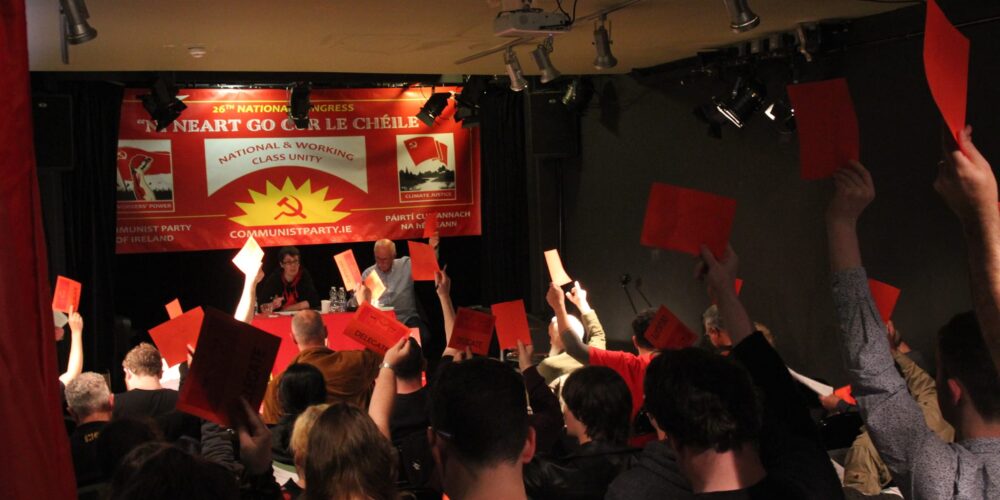



As we approach our 27th National Congress, it is worth taking a moment to reflect on the nature and role of communist parties. Communist Parties were founded on the principles of scientific socialism: an outlook identifying dynamics of social change in the economic structure and its associated class relations, via an analysis of the laws of capitalism. The Communist Parties emerged as the historical form through which these dynamics could be understood and acted upon. In this sense, “the Party” is not merely a left organisation among others: it is the political instrument through which the working class grasps its historical role and undertakes the necessary action to move beyond the capitalist mode of production.
By identifying those who sell their labour power to capital as the social force capable of advancing society to a more rational stage of development, the Party form seeks to organise and lead the working class in that direction.
The Communist Party is not a party of the amorphous or eclectic left, nor of non-scientific socialism. Rather, it draws into its ranks the most advanced elements of society – those who grasp, or accept, the principles of scientific socialism – and unites them around the task of overcoming capitalism. Despite historical zigzags, defeats and reversals, this remains a Communist Party’s primary mission.
Our Communist Party, as per the constitution, is specifically a Marxist-Leninist party whose primary aim is ‘The ending of the capitalist system and for building socialism, a social system in which the means of production, distribution and exchange are publicly owned and utilised for the benefit of the whole people.’ (Art 4. of the Constitution).
The principal role of a Communist Party, therefore, is to raise class consciousness within the working class: both industrial consciousness, the recognition of their position as commodified exploited labour under capital, and political consciousness, the understanding that political and state power are the necessary means for breaking the stranglehold of capital.
The Communist Party must be at the forefront of propagating an understanding of the true social position of the working class under capitalism and organising workers into forms that give this understanding real force.
This is the very specific and unique role of the Communist Party form. It is different from the shifting concerns of left activism, the transient leftist issues of the day or the endless cycle of leftist campaigns and protests. The politics of a Communist Party is not one thing to be prioritised this week and another thing the next. It is not joining in issues just because they are popular or everyone else on the left is.
We should speak about urgent everyday political issues, but is it our role to organise around every emerging crisis, popular trend or humanitarian cause? Instead, it is that of a disciplined party cadre focused solely on increasing industrial and political consciousness of scientific socialism and its critique of capitalism amongst the working class.
It is worth noting that even the cadre who replenish the capitalist class and its managerial lieutenants are trained with a discipline absent on the left. From the moment they enter business schools, students are taught the principles of unique selling propositions and core competencies: identify what you do best and focus relentlessly on that task, excluding distractions.
Communists might grasp this lesson. Our core competencies are the scientific analysis of capitalism, the development of working-class consciousness, and the organisation of the working class as an independent industrial and political force capable of wielding state power.
That focus must be disciplined and unwavering and not subordinated to leftist momentary preoccupations. That requires Party education, a strategic focus and disciplined prioritisation. It requires subordinating one’s own interests or passions to the Party’s focus. The National Congress is an opportunity to renew that focus.