

In this sprawling epic, Christopher Nolan takes Odysseus, the Trojan War veteran of mythic poetry, and fashions him into the everyday used-up soldier who has survived the imperial misadventure; left living with guilt over foul deeds committed in battle, and the ache of lost and betrayed comrades. Without abandoning its mythical substrate, the film sympathetically explores the weight borne by the foot-soldiers of empire, as they reach the haunting realisation that coming home from war isn’t as straightforward as it sounds, assuming one makes it out alive.
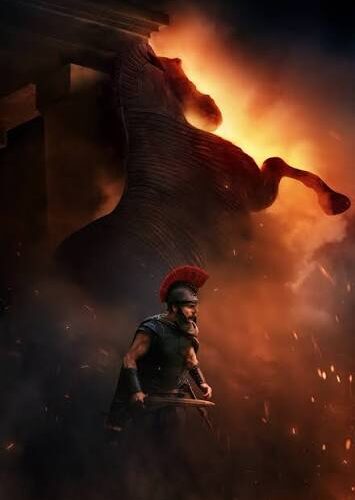
Matt Damon’s Odysseus veers between unknowable cipher, shrewd tactician, bumbling oaf, tortured conscience and avenging demigod. King of the island of Ithaca, he is drawn into the Trojan War by his liege, Agamemnon – a towering figure of taciturn menace in a fanciful suit of armour that cloaks him in darkness and evokes science fiction more than late antiquity. Victorious after a decade-long siege following some equine deception, Odysseus is compelled by forces beyond his comprehension to return home via a circuitous route where he is beset with supernatural misfortunes at every turn. While he seeks a path back to Ithaca, his ever-faithful wife Penelope (Anne Hathaway) and son Telemachus (Tom Holland) are bound by custom to feed and entertain an array of obnoxious suitors who seek to marry Penelope and claim the throne of Ithaca for themselves; none so odious as Robert Pattinson’s exquisitely slimy Antinous. Tormented by the gods, Odysseus must island-hop his way across the Aegean as he seeks to be reunited with his family, save the lives of his men, and come to terms with the spiritual toll that victory has taken on him.
As a spectacle, the film is excellent. The non-linear narrative builds multiple lines of tension as the characters cut from youthful warriors to jaded survivors, to nervous combatants, to joyous victors and back again. The visuals are rich and deep, the soundscape immersive and penetrating. The mythological adversaries faced by Odysseus’ crew are realised in grim detail where it serves the story to terrify, and shown in haze and shimmer when the narrative requires mystery and allure, as in the episode of the sirens. A trip to Hades to confer with the shades of his dead comrades borders on horrific. The baseline of the film is Homer’s Odyssey, but Nolan borrows from the Iliad and Aeneid to flesh out the plot, feeling free to craft his own narrative from the deposit of mythology.
So far, so good. So what about the deeper meaning? Perhaps unsurprisingly, The Odyssey is as much about today and the world we live in as it is about Greek prehistory. When Odysseus is explaining his upcoming departure to his wife, he does away with the notion that the war he is about to wage is over a matter as incidental as a marital dispute. Dismissing the propaganda, he confides to his wife; “this is Agamemnon’s excuse to break Troy’s control of the trading routes”. In the cold, hard calculus of imperialism, propaganda is the smokescreen that hides the economic interests that direct political decision-making. Circe, a witch with the power to transform humans into animals, accuses Odysseus with a voice full of venom of the terrible things that happen to women when war brings them into contact with male violence. As the film opens, Odysseus has trouble remembering himself and his past life, as he is fed memory-destroying lotus flowers by Calypso, calling to mind the role that substance abuse plays in the post-deployment lives of so many soldiers, once they have rendered their service to imperialism. This is the ambiguity of the film; Nolan shows us a sympathetic Odysseus, repulsed by the violence his men committed against the civilian population of Troy, overseeing the burial of his men in sand in a way that evokes the soldiers’ crosses seen in the United States’ invasion of Iraq, troubled by the seemingly inevitable coming collapse of “the greatest civilisation ever known”. Odysseus is allowed the luxury of being traumatised by the weight of the violence he has committed, but in the silence of the victims, the lessons of the film remain ambiguous.
4.5/5 stars.